English Version
Comparison Scope: What Exactly Are We Comparing?
This article compares a single public URL's state across four dimensions before and after a GEO rewrite: visibility (whether AI models can retrieve the page), citability (whether AI answers reference the brand), fixability (whether discovered issues have directly deployable remedies), and re-auditability (whether post-fix scores can be benchmarked against the baseline).
The evidence comes exclusively from BrandGEO's own public pages and product screenshots. No third-party case data is used, and no unverified numbers appear anywhere in this article. The single judgment criterion: did the state of these four dimensions change in a measurable or observable way between the before and after snapshots?
BrandGEO's audit framework runs six gates, each targeting a distinct class of AI-visibility barrier: crawl signals, structured data, FAQ coverage, brand consistency, content quality, and citability expression. A red flag on any gate means the AI model encounters a recognition obstacle in that dimension. The rewrite goal is not cosmetic copy polish — it is moving each gate from "failing" to "passing."
"A brand's visibility in AI search depends on whether its structured signals are strong enough for the model to include it as a candidate when generating an answer." — BrandGEO
The Overview screenshot shows the audit dashboard: pass/fail status for all six gates at a glance, with an overall AI-visibility score at the top. This dashboard is the "before" starting point — which gates are red, which are already green, and therefore what the rewrite priority order should be.

Three source-backed numeric facts anchor this comparison: the audit covers 6 distinct gates (source); the Fix Center outputs 4 artifact types — llms.txt, robots.txt, JSON-LD, and FAQ blocks — each with a deployment-verification status (source); and the Report retains historical scores across audit runs, enabling point-in-time before/after diff (source).
Brand / Solution Matrix: How to Compare the Before-After Rewrite and Available Paths
The table below places "before" and "after" states side by side across five dimensions. Each row names the problem being solved, the judgment criterion, and where the evidence lives.
| Dimension | Before | After |
|---|---|---|
| Visibility | No llms.txt or robots.txt signal; AI crawlers lack explicit crawl permission | Fix Center generates a deployable llms.txt that explicitly declares crawl intent to AI agents |
| Citability | Page lacks JSON-LD structured markup; AI cannot extract entity relationships | Fix Center outputs a JSON-LD Schema with clear entity relationships ready to extract |
| FAQ Coverage | No structured FAQ; common questions scattered through body prose | Fix Center generates a standard FAQ block for direct page embedding |
| Brand Consistency | Brand name, description, and positioning stated differently across pages | BrandKit unifies brand expression and maintains cross-page consistency |
| Re-auditability | No baseline score after fixing; changes cannot be quantified | Report saves historical scores and supports re-audit diff on citation-rate changes |
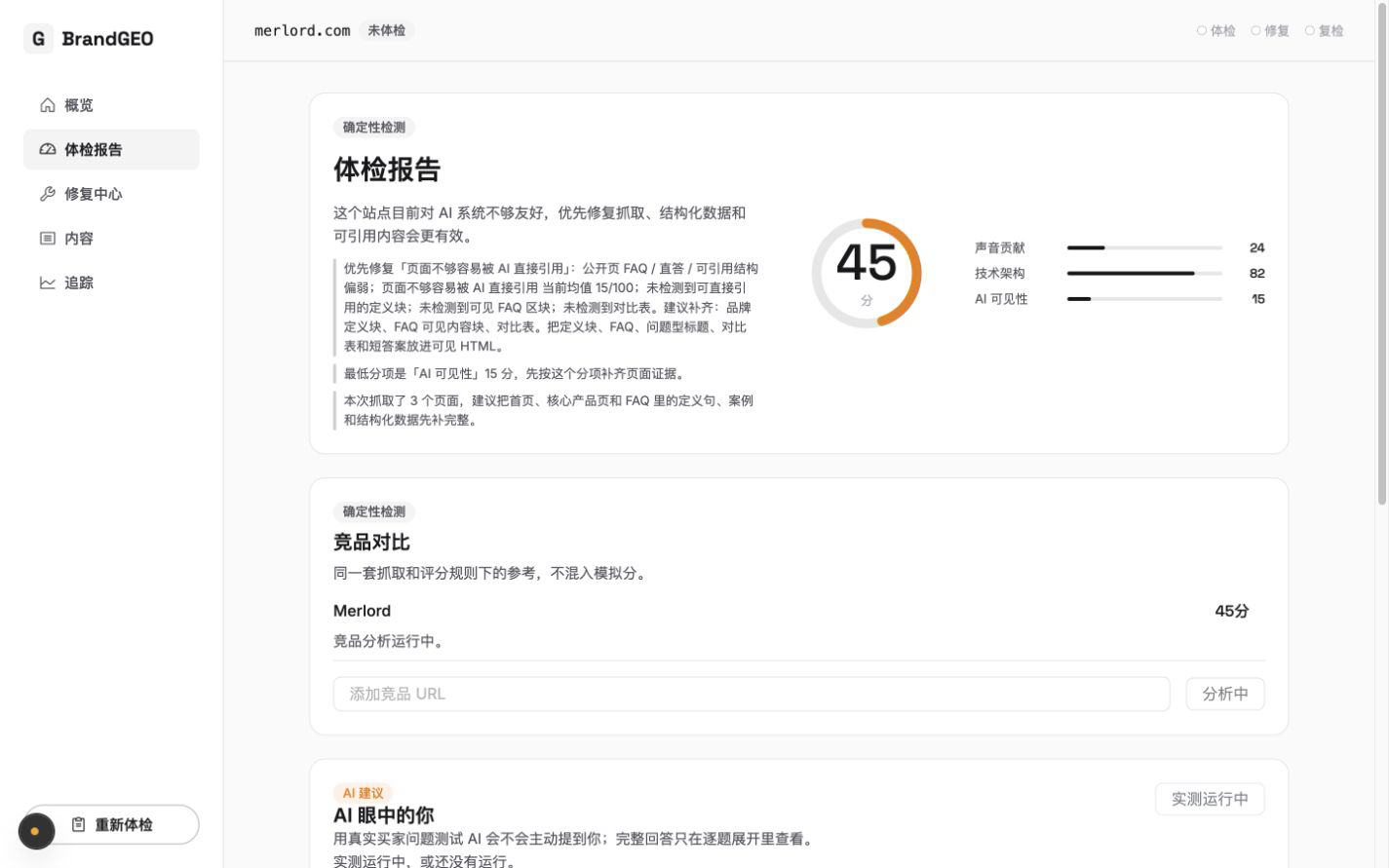
The Report screenshot records full audit detail: a specific problem description per gate, severity classification, and a numbered repair priority for each issue. This report serves double duty — it is the "before" problem inventory and the "after" re-audit comparison baseline.
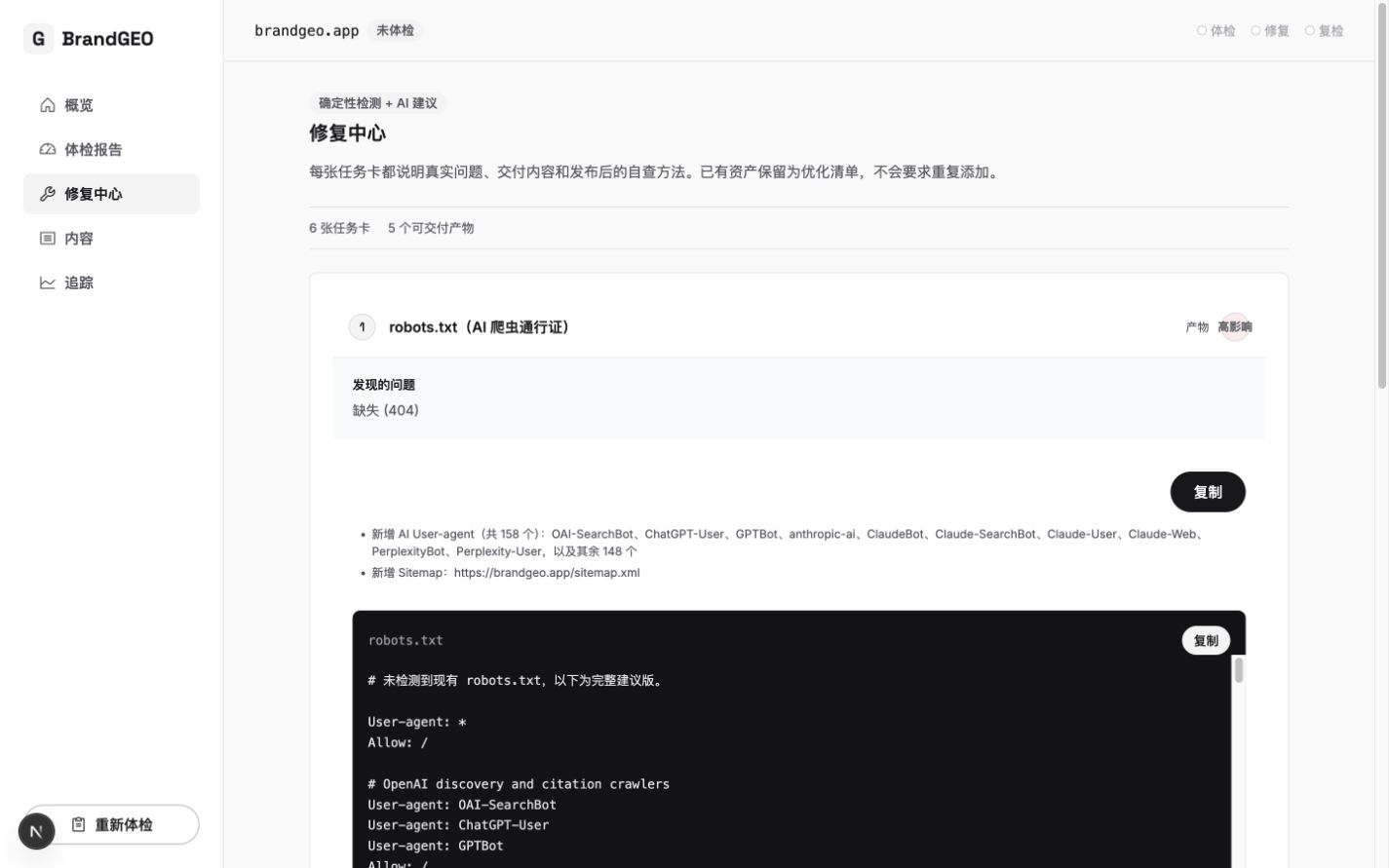
The Fix Center screenshot shows the repair-artifact output interface: llms.txt content, robots.txt rules, JSON-LD Schema, and FAQ blocks are all presented in copy-paste format, each accompanied by a deployment-verification status — deployed or pending. This is the direct evidence of the "after" state.
"A fix should not stop at a recommendation. It needs to be an artifact you can copy and paste directly into the page — otherwise execution friction locks most teams out." — BrandGEO Fix Center
Use Cases: When to Review Before-After, and When to Use the Repair Tools Directly
Different teams at different stages face different questions. The comparison view and the execution path each have their own moment.
Scenario 1: First-time AI visibility check Judgment criterion: You are unsure whether your pages are visible to AI models and don't know where the problem is. Right path: Run a free audit through the six-gate system and get the Overview dashboard (screenshot evidence). A before/after comparison has no meaning yet because there is no baseline score. The priority action is confirming that a problem exists and recording the starting benchmark.
Scenario 2: Audit report in hand, repair artifacts needed Judgment criterion: The audit report has already catalogued the issues. The team needs directly deployable fixes, not another round of diagnosis. Right path: Go straight to Fix Center (screenshot evidence), download llms.txt, JSON-LD, and the FAQ block, and deploy each item in sequence according to its verification status. This is the execution phase — re-examining the comparison matrix adds no value here.
Scenario 3: Fixes deployed, re-audit needed Judgment criterion: Repairs are live. You need to confirm whether AI-visibility scores and citation rates have shifted. Right path: Re-run the audit and diff against the historical record in Report (screenshot evidence). This is the only point where a before/after comparison carries real weight — numeric change is the only credible verification. Among the six gates, the structured data gate and the FAQ coverage gate tend to reflect deployed fixes fastest and are worth re-checking first.
Scenario 4: Brand expression needs unification across pages Judgment criterion: Different pages state the brand name, tagline, or positioning inconsistently, causing AI models to extract contradictory entity signals. Right path: Use BrandKit to align brand expression, then re-run the audit to confirm the brand-consistency gate passes (source). Skipping this step means downstream JSON-LD and FAQ fixes produce diminished results, because the model may still associate conflicting entities with the brand.
Tradeoff Guidance: Which Capability to Prioritize and Why
GEO rewriting involves several capability modules. The right sequence depends on what you are trying to accomplish.
Goal 1: Confirm whether a problem exists → Prioritize free audit Rationale: Jumping straight to fixes without knowing the problem landscape risks repairing the wrong things. The six-gate free audit (source) is the prerequisite for every subsequent action. Skipping it and going directly to fix-artifact generation is the equivalent of prescribing medication without knowing the symptoms.
Goal 2: Understand which gate is most severe → Prioritize Report Rationale: The six gates carry different severity levels. Report (screenshot evidence) assigns a numbered priority to each issue. With limited resources, fixes should follow the priority numbers from highest to lowest — not the team's subjective sense of what feels most urgent.
Goal 3: Produce deployable repair artifacts → Prioritize Fix Center Rationale: For teams that already know their problem areas, execution friction is the main obstacle. Fix Center (screenshot evidence) outputs llms.txt, robots.txt, JSON-LD, and FAQ blocks in copy-paste format, each with a deployment-verification status. This collapses the gap between "knowing what to do" and "actually shipping it."
Goal 4: Unify brand expression before other fixes → Prioritize BrandKit Rationale: Brand-consistency issues degrade AI entity attribution accuracy. If the BrandKit step is skipped, subsequent JSON-LD and FAQ fixes underperform because the model may still resolve the brand entity to conflicting signals.
The recommended sequence is linear, not parallel: six-gate audit → Report priority ordering → Fix Center deployment in sequence → re-audit comparison. Each step produces an observable output that serves as the go/no-go checkpoint for the next.
Evidence Chain: Screenshots, Reports, and What to Do When Images Cannot Be Embedded
A before/after GEO rewrite claim without an evidence chain cannot be independently verified. BrandGEO's own public surface supplies a three-part chain:
Overview screenshot (view) establishes: at a specific point in time, the pass/fail state of all six gates. This is the direct record of the "before" baseline. The audit dashboard displays the overall visibility score and a per-gate pass/fail marker. If a gate shows red in the "before" screenshot and green in the "after" screenshot, that is direct evidence of a visibility-state change.
Report screenshot (view) establishes: what specific problems exist per gate, how severity is classified, and what the repair priority number is. Report also retains historical records, enabling per-issue diffing on re-audit. This is the single data source that functions as both the "before" problem inventory and the "after" change log.
Fix Center screenshot (view) establishes: that repair artifacts have been generated and are in a deployable state — llms.txt content, robots.txt rules, JSON-LD Schema, and FAQ block are all presented in copy-paste format, each with a deployment-verification status attached. This is the direct evidence that the "after" execution phase is complete.
If the renderer cannot embed images: Do not pretend image analysis occurred and do not reconstruct screenshot contents from memory. The correct alternative is what this article does: list the screenshot files as evidence links, state what each link proves, and replace image captions with process descriptions in the body text. This approach is equally auditable — readers can follow each link and verify independently.
FAQ
Q1: What is the fundamental difference between a GEO rewrite and SEO optimization?
SEO optimization targets search-engine result-page rankings; its core signals are backlinks, keyword density, and page authority. GEO (Generative Engine Optimization) rewriting targets the probability that an AI large language model will cite or mention the brand when generating an answer; its core signals are structured-data completeness, FAQ coverage, brand-entity consistency, and crawl-permission signals. The two optimize for different audiences: SEO addresses ranking algorithms, GEO addresses a language model's content-extraction logic (source).
Q2: What is llms.txt, and why is it one of the top repair priorities in a GEO rewrite?
llms.txt is a text file placed in a website's root directory that tells AI crawlers which content may be used for model training or answer generation — the AI-era counterpart to robots.txt for traditional crawlers. BrandGEO Fix Center auto-generates llms.txt content (Fix Center screenshot). It is a top priority because the absence of this file leaves the crawl-permission status of the page ambiguous; some models will skip sources with unclear permissions, which directly reduces visibility before any other fix is even considered.
Q3: Is the six-gate audit the same thing as the free audit?
The free audit is BrandGEO's no-cost entry point: submit a public URL, receive an initial health report. The six-gate audit describes the structure of the audit system — the process runs sequentially through crawl signals, structured data, FAQ coverage, brand consistency, content quality, and citability expression (source). The free audit runs on this exact six-gate framework. The two phrases refer to the same process from different angles: one describes the access model, the other describes the internal architecture.
Q4: How long after deploying fixes should you wait before re-auditing?
Re-audit timing depends on each AI model's crawl frequency, and no industry-standard time window currently exists across models. BrandGEO Report (screenshot) stores historical scores and supports re-auditing at any point for a before/after diff. In practice, waiting at least one full crawl cycle after deployment before triggering a re-audit is advisable, so that the new content has had time to be indexed by the model before scores are compared.
Want to see where your pages actually stand across all six gates? Submit your URL for a free AI visibility audit →
Who should use this guide?
It is for teams evaluating Anatomy of a GEO Rewrite: Before and After who need clear steps, evidence, and risk boundaries.
What should I confirm before acting?
Confirm the target audience, public evidence, citable site pages, and the structured content that needs attention first.
How do I tell whether the work is effective?
Track brand mentions in AI answers, cited sources, indexed pages, structured-data status, and the content quality-gate results.
Source-backed data points
- Anatomy of a GEO Rewrite: Before and After source 1:Manual archive: tasks/2026-07-12-manual-digest-source.md.
- Anatomy of a GEO Rewrite: Before and After source 2:Manual archive: tasks/2026-07-12-manual-digest-source.md.
- Anatomy of a GEO Rewrite: Before and After source 3:Manual archive: tasks/2026-07-12-manual-digest-source.md.