Same Question — Did AI Pick You or Your Competitor?
TL;DR
One AI answer cannot establish a lasting competitive position. This guide separates the three views in BrandGEO's Competitors tab: technical audit comparisons, measured mentions, and the question-by-question matrix. Check sample size, platform, and access limits before turning a difference into a specific fix or content task.
Why AI Recommends Competitors Instead of You
You've seen an uncomfortable result in the probe library: a high purchase-intent question — "recommend a tool for [your category]" — and AI recommended three competitors without mentioning you.
This doesn't happen randomly. ChatGPT, Perplexity, and other AI engines rely on multiple signals when generating recommendations, and your competitors may be stronger on these signals. Anagram's 2026 research identified four core factors: third-party source coverage density (volume and frequency of review sites, industry media, and Reddit discussions), content crawlability and structure, clarity and consistency of brand positioning, and information consistency about the brand across the web. [1]
Put simply: AI recommends brands it can "understand." If a competitor has accumulated extensive media coverage, review articles, and community discussions over five years while your brand primarily speaks through its own website — AI's "evidence library" simply contains more information about the competitor. Research shows that in a 450-run ChatGPT experiment, incumbent brands captured 64.3% of all recommendation slots. [2]
"AI recommends brands it can describe in one clean sentence — who it's for and what makes it different. If your category positioning, use case, and differentiation aren't stated plainly and consistently across the web, AI can't confidently slot you into an answer — so it reaches for a competitor it understands better." — TrustSignals Research [3]
Even more concerning is the compounding effect of early-mover advantage. Once an AI system selects a brand as a "trusted source," this choice reinforces itself across related queries — creating winner-takes-most dynamics. [4] This means: the earlier you start optimizing, the smaller the gap; the longer you wait, the harder the catch-up.
That's why you need to see competitive comparison data — not to "confirm you're losing," but to find exactly where the gaps are and close them one by one.
Understanding "AI Share of Voice"
In traditional search, the competitive dimension between you and competitors is keyword ranking — you're third, competitors are first. In AI search, this dimension becomes AI Share of Voice (AI SOV).
AI Share of Voice is calculated by dividing your brand's mention count by the total mentions across you and all competitors. For example, across 120 probe questions, if you're mentioned 38 times, Competitor A 52 times, and Competitor B 30 times — your AI SOV is 38/(38+52+30) = 31.7%. [5]
2026 benchmark data shows: achieving 30%+ AI SOV in your core category signals strong positioning. [6] With 73% of B2B buyers using AI tools during their research process, [6] AI SOV is transitioning from "interesting new metric" to "leading indicator" — it foreshadows future market share shifts.
Understanding this concept helps you use the Competitors page's three comparison cards more effectively.
Step by Step: Reading the Competitors Comparison
The Track dashboard's Competitors tab is where you conduct competitive analysis. Enter from Overview or the Prompts probe library — when you discover competitors outranking you on certain questions, this is where you do systematic comparison.
The Competitors page has three comparison cards, each answering a different-level question.
Step 1: Deterministic Audit Comparison — Who Has Stronger Technical Foundations
The first card is the deterministic audit comparison. It doesn't compare "did AI mention you" — it addresses a more fundamental question: from a technical standpoint, can AI crawlers read your website and your competitors' websites?
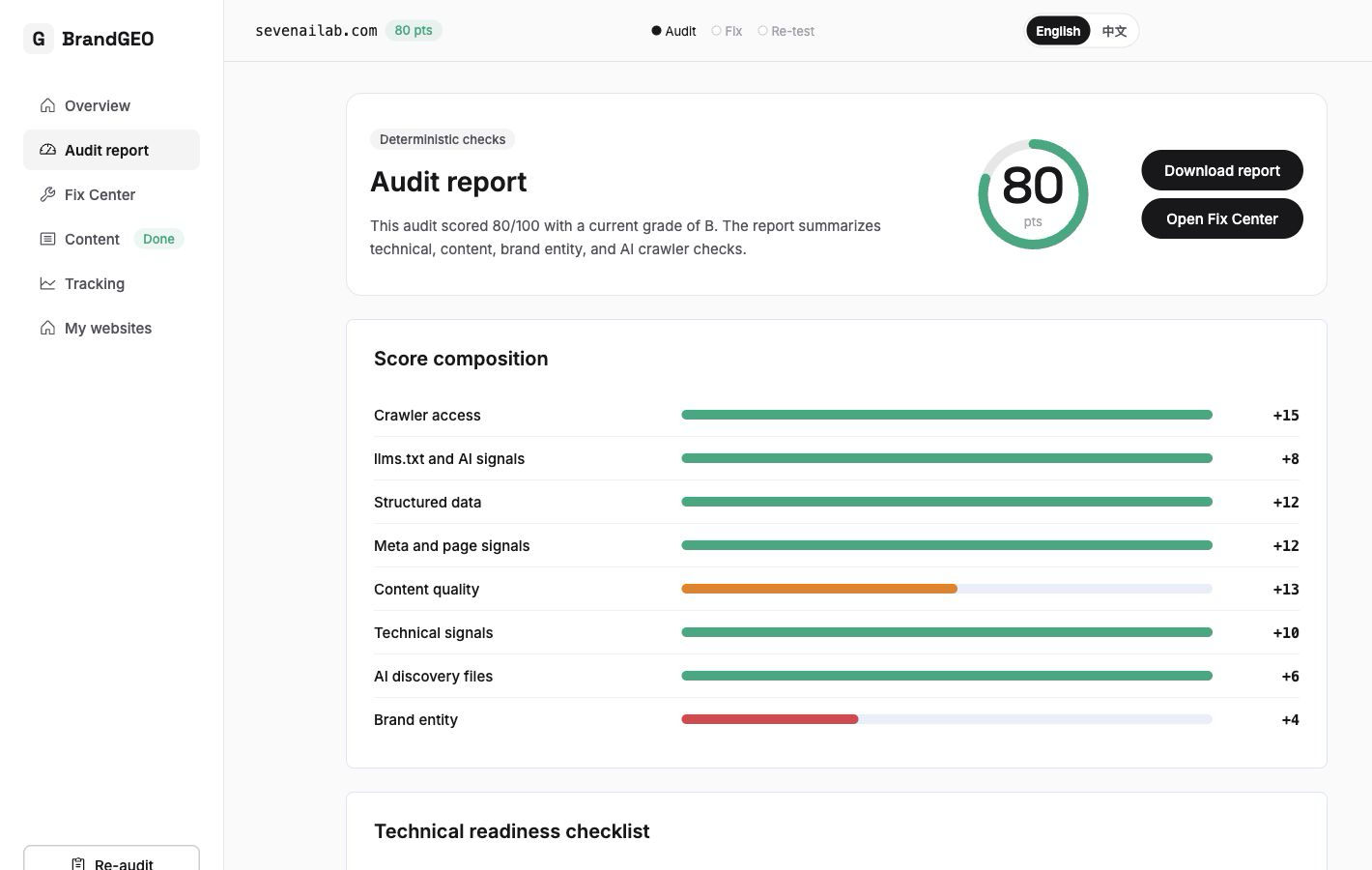 Deterministic audit comparison: compares your AI technical readability scores against competitors. Green means pass; red means issues.
This card compares dimensions including: whether AI crawlers are blocked by robots.txt, whether llms.txt exists, whether structured data is complete, and whether pages are crawlable. These are all deterministic indicators — they have clear "pass/fail" results, unlike mention rates which are affected by AI response randomness.
Why is this card first? Because technical readability is the prerequisite for everything else. If your website blocks GPTBot while your competitor doesn't, AI simply cannot reference your pages when generating answers — regardless of how good your content is. Research shows 97% of Google AI Overviews citations come from pages in the top 20 organic results [7] — if your technical foundation is weaker than competitors', your starting line in AI search is already behind.
The most valuable approach: look for "red vs. green" comparisons between you and competitors — dimensions where competitors pass and you don't are your technical gaps. These gaps can usually be quickly closed through one-time technical fixes.
Step 2: Measured Mention Comparison — Who Gets Mentioned More
The second card is the measured mention comparison. It's based on actual probe data — across all probe questions, how many times were you and each competitor mentioned, what are the mention rates, and what's each brand's AI SOV.
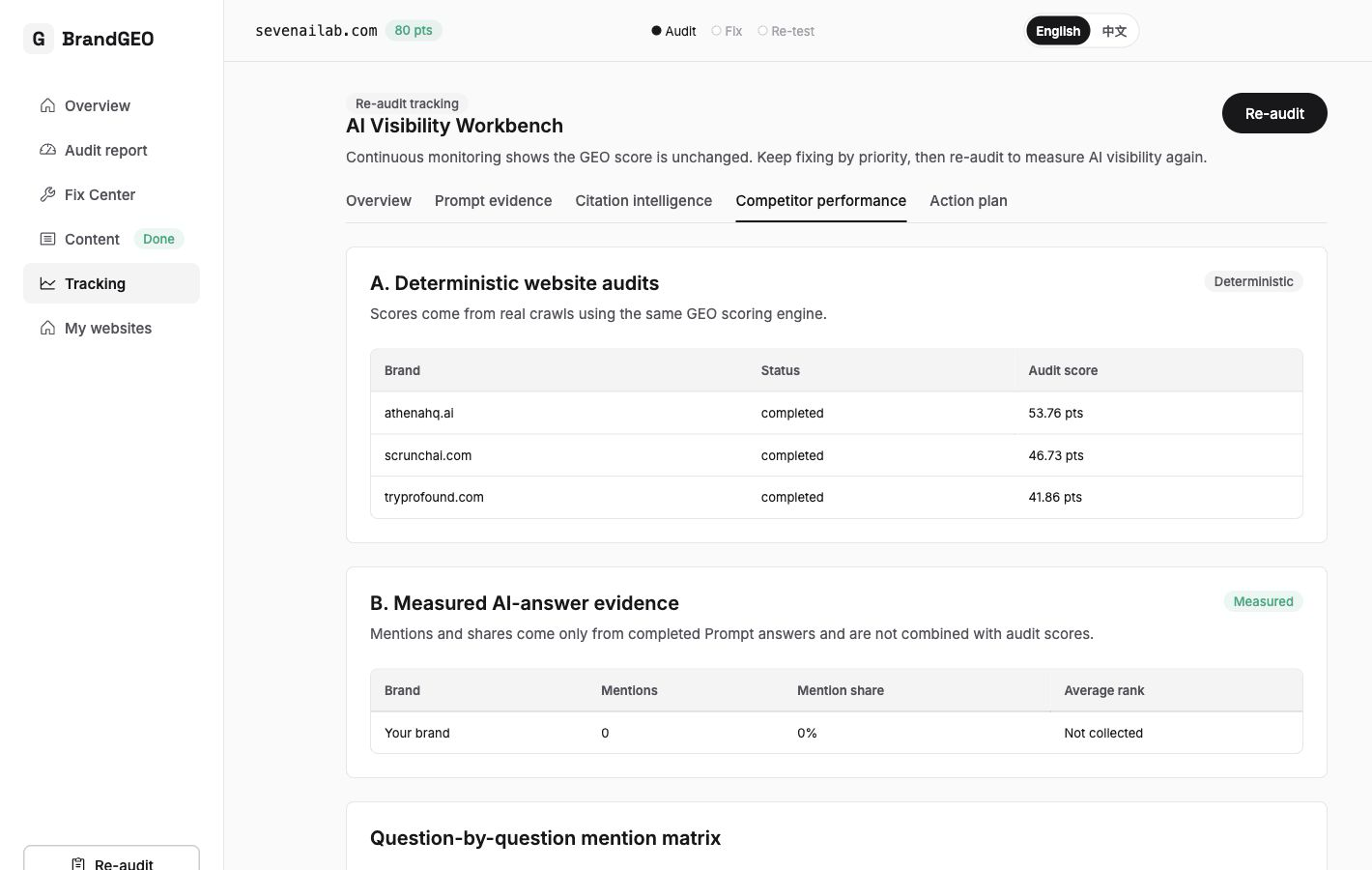 Measured mention comparison: based on real probe data, comparing your mention frequency and AI Share of Voice against each competitor.
This card tells you the overall competitive landscape: in AI's eyes, where do you rank in your category? An AI SOV above 30% means you're competitive; below 10% means you're essentially invisible in AI search.
But numbers alone aren't enough — you need to understand what's behind them. The average brand mention rate is only 17.2%, [8] so don't expect 100%. The key is trends and relative position: is your share growing or shrinking? Is the gap between you and the biggest competitor widening or narrowing?
AthenaHQ's research also found that the first brand mentioned in an AI response has a 2.8× higher conversion rate than the third-mentioned brand. [4] This means even if you and a competitor are mentioned the same number of times, but the competitor is more often mentioned first — that's a critical gap.
Step 3: Head-to-Head Matrix — Per-Question View of Who AI Chose
The third card is the head-to-head matrix — the most granular and most actionable view on the Competitors page. It expands each probe question into a row, listing whether you and each competitor were mentioned (using "mentioned/not mentioned" badges), letting you see AI's choice on a per-question basis.
Head-to-head matrix: rows are probe questions, columns are you and competitors. Each cell shows whether that brand was mentioned by AI for that question. The most granular competitive view.
The head-to-head matrix helps you discover three types of key patterns:
Questions where only you are mentioned — you're mentioned but competitors aren't. These are your differentiation strongholds in AI search. Look at what these questions have in common — usually your content density in a specific sub-area far exceeds competitors. Strengthen these advantages to prevent competitors from overtaking you.
Questions where only competitors are mentioned — competitors are mentioned but you aren't. These are the gaps you need to focus on most. Expand these questions (from the Prompts probe library) and check competitors' citation sources — you'll typically find competitors have content you don't: a Reddit discussion post, a G2 review, an industry blog recommendation. These are content gaps you need to fill.
Both mentioned but competitor ranks higher — you and the competitor both appear, but the competitor consistently ranks above you. Research shows the first-mentioned brand gets 3.1× the click-through rate of brands listed fifth or later. [9] To improve your ranking, increase the density and diversity of third-party sources — distributing content across multiple publications generates 3.25× more AI citations than publishing on the brand's own website alone.
How to Turn Competitive Comparison Into Action
After reviewing all three cards, your action priorities should be:
First priority: Fix technical gaps. If the deterministic audit comparison shows competitors have higher technical readability scores — especially dimensions where they pass and you don't — these are the easiest, fastest fixes. Go to the Fix center and resolve them at once. Without fixing technical gaps, subsequent content optimization will be less effective.
Second priority: Fill content gaps on high-intent questions. From the head-to-head matrix, find questions where "competitor mentioned but you're not" among high-intent queries (like "recommend a [category] tool"). Check competitors' citation sources for these questions — if competitors are cited from Reddit posts or industry reviews, you need to build presence on similar platforms. With 84% of AI citations from third-party sources, [10] optimizing your own website matters, but closing third-party source gaps is typically more directly effective.
Third priority: Strengthen your unique advantages. Don't just focus on gaps — also fortify areas where you lead. If you're stably ranked ahead of competitors on certain questions, analyze what content drives AI to favor you, then keep strengthening it (update content, add sources, maintain content freshness).
"The single most useful AI Share of Voice benchmark is: relative to your named competitors, is your share growing or shrinking." — LLM Pulse [5]
If you're unsure what to do first, the Track dashboard's Actions priority plan ranks recommendations based on competitive data and other dimensions.
What You'll See After This
After spending 10 minutes reviewing Competitors' three cards, you'll have four clear insights:
- Technical gaps — who's more readable by AI between you and competitors
- Overall competitive position — your AI Share of Voice in the category
- Per-question wins and losses — which brand AI chose for each question
- Source of the gaps — what content competitors used to beat you
These four insights transform your next step from the vague goal of "optimize everything" to something precise like "on these 5 questions, competitors won because of content on Reddit and G2, so I need to build content on those two platforms." Data refreshes automatically after each audit — next time, check whether your AI SOV has changed and whether your "green cells" in the head-to-head matrix have increased. This is the practical operation of "competitive monitoring" in the complete GEO closed loop.
Frequently Asked Questions
How does AI Share of Voice differ from traditional search rankings?
Traditional search ranking is about "which page, which position" — you're third, competitors are first, and users can scroll down to find you. AI search has no "ranking list" — AI generates a response that either mentions you or doesn't. AI SOV measures "across all relevant responses, what percentage mention you." With 35% of U.S. consumers now using AI tools rather than search engines to discover products, [11] AI SOV is becoming equally important as search rankings.
In the head-to-head matrix, "both mentioned" but competitor ranks above me — is the gap significant?
The gap may be larger than you think. Research shows the first-mentioned brand has a 2.8× higher conversion rate than the third-mentioned brand. [4] In AI search, users tend to directly use the first or second recommended brand, and later-listed brands are easily overlooked. If you rank below competitors on most questions, you need to increase third-party source coverage density to improve your ranking position.
Competitors have much higher AI SOV than me. Can I catch up?
Yes, but it takes time and targeted testing. Existing reports discuss concentration and first-mover effects,[4] but they do not prove that one brand will keep being selected. One practitioner guide cites cases improving within 60–90 days,[9] which is not a universal 30%–40% promise. Identify the competitor's concrete source advantage, form a hypothesis, and re-test instead of spreading effort everywhere.
Why is the deterministic audit comparison listed first?
Because technical readability is the prerequisite for everything. If your website blocks AI crawlers or lacks structured data, AI can't read or cite your content regardless of quality. The deterministic audit comparison checks "hard" technical indicators — these have clear pass/fail criteria, aren't affected by AI response randomness, and can typically be resolved quickly through one-time technical fixes. Fix the technical foundation first, then optimize content.
My brand is mentioned on some questions where competitors aren't. What does this mean?
This means your AI visibility leads competitors on these topics — these are your differentiation strongholds. It typically indicates stronger content density or third-party citation coverage in this specific area. Actions: (1) analyze what these questions have in common — is it your blog covering a niche topic? Are you particularly active on an industry forum? (2) Strengthen this advantage — continue publishing related content to prevent competitors from catching up.
Are competitive comparison results the same across different AI platforms?
Usually not. Research found only 11% of websites are cited by both ChatGPT and Perplexity. [12] This means you might lead competitors on ChatGPT but trail them on Perplexity. Different platforms cite different sources — ChatGPT favors Wikipedia and authoritative media, while Perplexity relies more on Reddit and community content. [13] The head-to-head matrix lets you filter by platform to see your relative position on each one.
How often should I check Competitors data?
At least monthly, with additional checks at key moments (after competitors launch new products, after you complete a round of content optimization). The most valuable AI SOV benchmark is "the trend" — a single month's absolute number has limited meaning; three consecutive months of trend data tells you whether you're heading in the right direction. [5] Data refreshes automatically after each audit.
How does Competitors data relate to Prompts and Citations?
The three are different-dimension views. The Prompts probe library is "per-question view of your own performance" — how AI answered each question and whether it mentioned you. Citations source library is "where AI learns about you." Competitors is "bringing competitors into the comparison" — across the same set of questions, who performs better. The typical workflow is: Prompts discovers "I wasn't mentioned on this question" → Competitors shows "was the competitor mentioned?" → if yes, Citations reveals "what sources got the competitor cited" → after finding the gap, go to Actions to confirm priorities.
Sources
- Anagram. "Why Does ChatGPT Recommend Some Brands and Not Others?" 2026. Four core recommendation factors: third-party coverage, content crawlability, brand positioning clarity, information consistency. Article
- ChatFeatured. "Why ChatGPT Recommends Your Competitors." 2026. Incumbent brands capture 64.3% of recommendation slots in 450-run experiment. Article
- TrustSignals. "Why Does ChatGPT Recommend Your Competitors Instead of You?" 2026. Brand positioning clarity impact on AI recommendations. Research
- Demand Local / 79 Development. "The State of AI Search 2026." Top 2% brands capture 78% AI recommendation slots; first-position 2.8× conversion advantage; compounding early-mover advantage. Report
- LLM Pulse. "Share of Voice in AI Search: How to Calculate It in 2026." AI SOV calculation methodology and benchmarks. Article
- Shadow / OptimizeGEO. "How to Measure AI Share of Voice." 30%+ AI SOV as strong positioning; 73% B2B buyers use AI tools. Article
- Digital Applied. "What Actually Gets You Cited in AI Search (2026 Data)." 97% of AI Overview citations from top 20 organic results. Research
- AthenaHQ. "State of AI Search 2026." Average brand mention rate 17.2%. Cited via GrowthOS
- Vismore. "Best Ways to Track Brand Mentions in AI Search (2026 Guide + 750 Response Study)." Includes sample observations and several 60–90 day cases; not a universal growth benchmark. Guide
- Muck Rack. "The State of AI Citations 2026." Across 25 million cited links, an average 84% pointed beyond brands' owned channels. Report
- Axis Intelligence. "Consumer AI Discovery Behavior." 2026. 35% of U.S. consumers use AI tools to discover products. Cited via MaxAEO
- Profound. "AI Platform Citation Patterns." Only 11% of sites cited by both ChatGPT and Perplexity. Article
- KIME. "The 5 Most Cited Domains in AI Answers 2026." Platform-specific citation source differences. Research
Last updated: 2026-07-23
Want to see where the gap between you and competitors lies in AI search? Open BrandGEO for a free audit, then check the Track dashboard Competitors page for competitive comparison data. Start your free audit