When AI Cites You, Which Page Is It Actually Citing?
TL;DR
A brand mention and a citation are different signals. This guide shows how to use BrandGEO's Citations view to inspect cited domains and individual URLs, distinguish your own pages from third-party sources, and review YouTube and Reddit references. Use the observed records to choose the next content or outreach task.
Why "Being Mentioned" Is Only Half the Answer
You may have already seen in the probe library which questions AI mentions your brand on. That's good news — but it only answers half the question. The other half is equally critical: when AI recommends you, which web pages is it citing?
This question matters because the sources AI cites determine whether its description of your brand is accurate. If AI is citing a three-year-old blog post of yours, an outdated Reddit comment, or a third-party review site's old data — its brand description may contain inaccurate information. Being mentioned but mentioned incorrectly is sometimes worse than not being mentioned at all.
Citation sources differ by platform, question, and sample.[1] Inspect your own recorded answers to see whether sources are your site, industry publications, forums, review pages, or video. A cross-platform percentage cannot be applied to an individual brand without measurement.
"After analyzing over 6.8 million AI citations, we found that the AI search citation pipeline runs through a small set of third-party sources rather than brand-owned websites — the top 15 domains account for 68% of citation share." — 5WPR, AI Platform Citation Source Index 2026 [2]
This level of concentration has no precedent in search history. Traditional Google search results are far more distributed. For brands, this means your image in AI search largely depends on how these third-party sources write about you — not how your own website describes itself.
So which specific sources shape AI's brand perception? KIME's 2026 research identifies the top five: Reddit, YouTube, Wikipedia, LinkedIn, and Trustpilot. [3] Four are user-generated content platforms and one is a review site. No brand-owned media makes the top five.
Even more notable are the platform differences. Reddit accounts for 1.8% of citations on ChatGPT but 6.6% on Perplexity — nearly a 4× gap. [4] LinkedIn climbed from approximately #11 on ChatGPT in November 2025 to #5 by February 2026, the largest authority shift observed during the study period. [2] A source that cites you on one platform may not appear on another — only 11% of websites are cited by both ChatGPT and Perplexity. [5]
That's why you need to examine specific citation source data, not just look at "how many times was I mentioned."
See What Your Citation Sources Look Like
The Track dashboard's Citations tab is where you view citation sources. If you've already run an audit and seen per-question results in the probe library, Citations aggregates all sources AI cited across those probes, helping you answer "where does AI learn about me?"
On the Citations page, you'll see four sub-tabs: By Domain, By URL, YouTube, and Reddit. Each view answers a different question. Let's walk through them.
Step by Step: Reading the Citations Source Library
Step 1: By Domain View — Which Websites Inform AI
"By Domain" is the default Citations view and should be your first stop. It aggregates all citation sources by domain, using a proportion bar chart to show each domain's percentage of total citations.
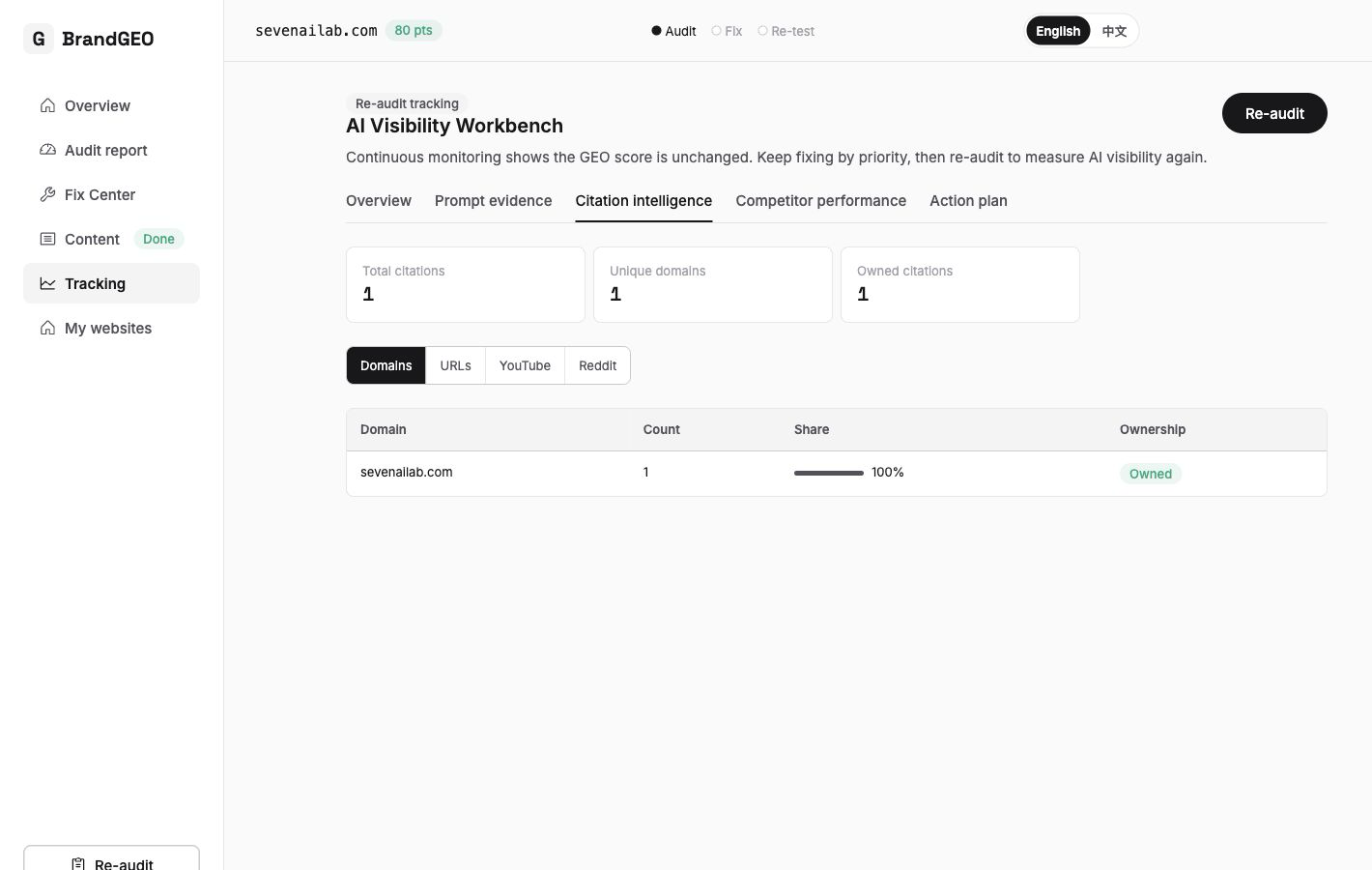 By Domain view: the bar chart shows each source domain's share of citations. "Owned" (green) indicates your website; "External" (gray) indicates third-party sources.
Each domain has an attribution badge — the most intuitive classification tool on the Citations page:
- Owned: Your own domains — your website, blog, help center, etc.
- External: Third-party sources — review sites, media outlets, social platforms, community forums, etc.
This classification directly answers a key question: of the information that forms AI's understanding of your brand, how much can you directly control?
Research provides a benchmark: for most brands, only about 2.9% of AI citations point to brand-owned domains. [6] Among brand-related citations, 57% come from reviews and social proof (review sites, listicle articles, press coverage), 17% from directories, and only about 4.5% from the brand's own homepage, About page, or FAQ pages. [5]
If your "owned" percentage is far below "external," that's not necessarily bad — it's normal. The key is whether the "external" sources contain accurate information. If AI primarily cites a two-year-old G2 review, an outdated feature comparison post, or a misleading Reddit discussion — those are sources you need to "dilute" by publishing new content.
The most important signal to watch for: if your owned domain doesn't appear in the list at all — not a single citation — it means AI never directly references your website to describe your brand. This typically indicates technical readability issues with your site, or content structure that's not suitable for AI extraction (missing structured data, no brand profile).
Step 2: By URL View — Drill Down to the Specific Page
The "By URL" view is more granular than "By Domain" — it shows specific page addresses rather than domain-level aggregations.
This view answers more precise questions: not "AI learns about me from Reddit," but "which specific Reddit post does AI cite about me"; not "AI cites G2," but "which G2 review specifically."
By URL view: each row is a specific page, pinpointing which article, post, or review AI is citing.
Why is URL-level data more important than domain-level? Because different pages on the same domain can convey completely different information. Your website homepage describes your latest product features, but AI might be citing a three-year-old blog post where the features described have long since been updated. Similarly, a 2023 G2 review and a 2026 G2 review about you may project very different brand images.
BuzzStream's analysis of 4 million AI citations shows blog and content pages account for 53.46% of all citations — far ahead of news (14.09%) and social content (8.71%). [7] This means AI most frequently cites not your homepage, but long-form content — blog posts, guides, reviews, comparison articles.
After seeing specific URLs, you can take three actions:
- Click through to the URL and check whether the content is accurate and current
- Flag your own pages that need updating — if AI is citing one of your outdated pages, that's your priority for a refresh
- Flag external pages that need "diluting" — if a negative or inaccurate third-party page is frequently cited, you need to publish accurate information on the same platform to compete for citation share
Step 3: YouTube View — Video Sources Separated Out
YouTube is the second most-cited source in AI search. [3] AI engines — especially Perplexity and Google AI — cite YouTube video descriptions, subtitles, and comment sections when generating answers.
The "YouTube" sub-tab lists all citations from YouTube separately. You can see which videos AI cited — perhaps your own product demos, tech blogger review videos, user-uploaded tutorials, or competitor comparison videos.
YouTube view: separately view which YouTube videos AI is citing. Video titles and channel names are visible.
YouTube citations are a blind spot for many small businesses — you may have never considered that AI would draw information about you from a YouTube video. But if someone made a review video with inaccurate descriptions of your product, and AI happens to cite that video — those errors will appear in AI's responses.
If the YouTube view contains no videos from your own channel but features competitors' videos, that's a signal: your video content strategy is absent from AI search. Even publishing a single short product introduction or FAQ video can provide AI with a video source you control.
Step 4: Reddit View — How Community Discussions Shape AI
Reddit is the single most-cited domain across all AI platforms. [3] KIME's research data shows Reddit's citation frequency in AI search is approximately 40%, and it's especially prominent on Perplexity — accounting for 46.7% of Perplexity's top 10 citation sources, more than three times the second-place YouTube (13.9%). [8]
The "Reddit" sub-tab consolidates all Reddit-sourced citations. You can see which Reddit posts and comments about your brand AI is citing.
Reddit view: see which Reddit discussions about your brand AI is citing. Note the source subreddit and post date.
"If Reddit and Wikipedia don't know you, the LLMs don't either." — Vismore 50×5 Audit Report [9]
Reddit citations deserve special attention for three reasons. First, Reddit content is typically unvetted by the brand — users say whatever they want, including misinformation. Second, Reddit posts have long lifespans — a three-year-old post can continue to be cited if it remains the "best answer" for a topic. Third, new Reddit content gets cited by AI faster than other sources — the median time to appear in ChatGPT citations is 16 days, compared to 34 days for new pages on a brand's own domain. [9]
If the Reddit view shows posts unfavorable to your brand (outdated info, user complaints, misleading competitor comparisons), the response strategy isn't trying to delete them — it's publishing accurate, valuable content in the relevant subreddits, giving AI newer, more accurate Reddit sources to cite.
How to Turn Citation Source Data Into Action
After reviewing all four views, you'll have a clear understanding of AI's information foundation. Here are specific action recommendations for different scenarios:
Your owned domain citation share is extremely low or zero — this is the most urgent situation. First check whether your website has technical readability issues (crawlers blocked by robots.txt? No llms.txt?). If the technical side is fine, check your content structure — AI more easily cites pages with clear structure, FAQs, and structured data. Research shows 97% of Google AI Overviews citations come from pages in Google's top 20 organic results [10] — traditional SEO performance directly impacts AI citations.
External sources contain outdated or inaccurate content that's frequently cited — find these specific pages in the By URL view, then take two steps: first, publish accurate, current content on your own website (like a detailed product update blog or FAQ); second, create newer content sources on the same third-party platform (answer relevant questions on Reddit, update your product page on G2, ask satisfied customers to leave fresh reviews).
Competitors have far more diverse citation sources than you — go to the competitor comparison page for a systematic analysis. If competitors have cited content across Reddit, YouTube, and industry media while you only have your website — your "citation source coverage" is too narrow. Increasing source diversity is more effective than optimizing a single source: research shows distributing content across multiple publications generates 3.25× more AI citations than publishing on the brand's own website alone. [11]
YouTube/Reddit views contain none of your content — this means AI relies entirely on third parties' descriptions of your brand when citing these two most important platforms. Even a short product introduction video or a few high-quality Reddit answers can provide AI with source content you can influence.
If you're not sure about priorities, the Track dashboard's Actions priority plan page ranks recommendations based on citation source data and other dimensions.
What You'll See After This
After spending 10 minutes browsing Citations' four views, you'll know three things:
- Where AI learns about you — which websites and specific pages form the foundation of AI's understanding of your brand
- How much you can control — the ratio between owned and external sources
- Which sources need updating or supplementing — outdated content, inaccurate descriptions, missing platforms
These insights directly guide your next steps: whether to first fix website technical issues so owned content gets cited, build third-party sources on Reddit/YouTube, or update those frequently-cited outdated pages. Citation source data refreshes automatically after each audit — next time you check, see if your owned source share has increased and whether newly published content has entered the citation list. This is the practical operation of "source management" in the complete GEO closed loop.
Frequently Asked Questions
Why doesn't AI cite my website?
The three most common reasons. First, technical issues — your robots.txt blocks AI crawlers (GPTBot, ClaudeBot, etc.), so AI simply can't read your pages. BrandGEO's audit detects this in one click. Second, content structure — your pages lack structured information that AI can easily extract (no FAQ, no structured data, no clear product description paragraphs). Third, authority — research shows 97% of Google AI Overviews citations come from pages in the top 20 organic results, [10] so if your pages don't rank well in traditional search, AI is unlikely to cite them either.
What's the ideal ratio between "owned" and "external"?
There is no fixed ideal ratio. Different questions cite different types of sources; a single external-to-owned percentage does not establish success.[1] Check whether your own pages appear in the measured sample and whether external information is accurate. If owned citations are zero, inspect the probe questions and sample size before assuming a technical fault.
What's the relationship between Citations data and Prompts data?
The Prompts probe library is the per-question view — how AI answered each question and whether it mentioned you. When you expand a row in Prompts, you see the citation source list for that specific response. Citations is the cross-question aggregated view — consolidating all citation sources across all probes to show you the overall source distribution. Typically, you first discover in Prompts that "this response cited an inaccurate source," then see in Citations that "this source is cited across multiple responses" — the latter tells you the scope of impact.
Can I control which page AI cites?
Not directly — you can't tell ChatGPT to "cite my website instead of Reddit." But you can influence it indirectly. AI tends to cite: (1) pages with the freshest, most frequently updated content; (2) pages with clear structure and paragraphs that directly answer questions; (3) pages that rank well in traditional search. So regularly updating your core content pages, adding FAQ structure, and keeping your brand profile current — these all increase the probability of your owned pages being cited.
Competitors have sources on platforms I'm not on. What should I do?
This is the most direct action signal from Citations data. If competitors have cited content on Reddit, YouTube, and industry blogs while you don't, you need to establish presence on these platforms. The specific approach depends on the platform: participate in relevant Reddit discussions, publish product videos on YouTube, and seek media coverage or contribute guest posts to industry publications. Research shows distributing content across multiple publications generates 3.25× more AI citations than publishing on the brand's own website alone. [11] Visit the competitor comparison page for a more systematic gap analysis.
There are so many Reddit posts. How do I know which ones are influencing AI?
You don't need to guess — the Citations Reddit view directly shows you which specific posts AI cited. Focus on two types: posts with high citation frequency (appearing across multiple probe questions), and posts with inaccurate or outdated content. For the former, if the content is favorable to you, let it be; for the latter, publish more accurate, current answers in the same subreddit — new Reddit content takes a median of just 16 days to appear in AI citations. [9]
Why do YouTube videos also affect AI's description of my brand?
AI engines (especially Perplexity and Google AI) read YouTube video titles, descriptions, subtitles, and comments. If a tech blogger made a "Top 5 [your category] tools" video, AI might directly cite that video when generating recommendation lists. YouTube is the second most-cited source in AI search, [3] yet many brands have no video content strategy whatsoever. At minimum, publish a product introduction video to give AI a YouTube source you can control.
How often does citation source data update?
Every time you run an audit through BrandGEO, the system re-runs the probe library, and sources cited in AI engines' new responses automatically update on the Citations page. If you've just made optimizations (published new content, updated pages), wait 2–4 weeks before running the next audit. The median time for new Reddit content to be cited is 16 days, Medium articles 21 days, and new pages on a brand's own domain 34 days. [9] Give AI enough time to "see" your new content.
Sources
- Machine Relations. AI citation behavior across models, background on platform-specific sources; do not apply sample percentages to an individual brand.
- 5WPR. "AI Platform Citation Source Index 2026." May 2026. 6.8 million citations analyzed; top 15 domains account for 68% of citation share. Press Release
- KIME. "The 5 Most Cited Domains in AI Answers 2026." Top 5: Reddit, YouTube, Wikipedia, LinkedIn, Trustpilot. Research
- Search Engine Land. "AI search engines cite Reddit, YouTube, and LinkedIn most." Reddit 1.8% on ChatGPT vs. 6.6% on Perplexity. Article
- Averi AI / Profound. "AI Platform Citation Patterns." 11% of sites cited by both ChatGPT and Perplexity; 57% of branded citations from reviews and social proof; 4.5% from brand's own pages. Article
- Ranqo / Machine Relations. "Earned vs. Owned AI Citation Rates 2026." Brand-owned domains account for only 2.9% of AI citations. Research
- BuzzStream. "AI Citation Content Type Analysis." Blog/content pages 53.46% of citations; news 14.09%; social 8.71%. Data
- Everything-PR. "The 50 Most-Cited Websites in AI." Reddit 46.7% of Perplexity's top 10 sources; YouTube 13.9%. Article
- Vismore. "Best Ways to Track Brand Mentions in AI Search (2026 Guide + 750 Response Study)." Reddit citation median 16 days; Medium 21 days; brand domain 34 days. Report
- Digital Applied / SurferSEO. "What Actually Gets You Cited in AI Search (2026 Data)." 97% of AI Overview citations from Google's top 20 organic results. Research
- CiteMetrix / Machine Relations. "Earned Media vs. Owned Content AI Citation Rates 2026." Multi-publication distribution generates 3.25× more AI citations than brand-site-only publishing. Research
Last updated: 2026-07-23
Want to know which pages AI cites when mentioning your brand and which third-party sources shape your brand image? Open BrandGEO for a free audit, then check the Track dashboard Citations page for citation sources. Start your free audit