Ask 20 Questions to ChatGPT — How Many Times Were You Mentioned?
TL;DR
A single ChatGPT answer is a sample, not a stable mention rate. BrandGEO's Prompts view records questions, platforms, brand mentions, and supporting answer text. This guide shows how to filter and inspect those records, compare competitor mentions, and rerun the same questions after making a website change.
Why "Asking Once" Is Not Enough
You've probably tried opening ChatGPT and typing "recommend a tool for [your category]" to see if AI mentions you. If it did, you relaxed; if it didn't, you worried. But either result is unreliable.
The reason is simple: AI answers change every time. SparkToro and Gumshoe.ai ran the same question through ChatGPT dozens of times and found that the brand recommendation list changed in 38% of cases. [1] The one time you asked manually might have been the run where AI happened to mention you — but the next user asking the same question might see a completely different recommendation list.
This means a single test gives you at most a "snapshot" — it can't tell you your mention frequency, and it certainly can't tell you whether the trend is going up or down.
Peec AI analyzed over 37,000 AI responses and found encouraging news: as long as core intent remains the same, minor wording differences have minimal impact on brand mention rates. [2] The only time visibility drops significantly — by about 50% — is when semantic similarity falls to the 0.35–0.39 range, indicating a genuine shift in intent. [2]
"Brand mentions stay stable as long as core intent is consistent, so you don't need to worry about every wording variation — what you need is coverage across enough intent categories." — Peec AI research team [2]
This tells us two things. First, you need a set of questions (not just one) to track brand visibility — different questions represent different buyer intents, not variations of the same intent. Second, you need to run these questions multiple times, using aggregate data instead of single snapshots.
Industry research gives specific guidance on "how many questions are enough": most brands need 30–100 prompts for statistically meaningful visibility data. [3] For mid-market B2B brands, at least 60 is recommended; enterprise brands with multiple product lines should scale to 100+. [3] When you multiply by multiple runs and platforms (say, 60 prompts × 5 runs × 3 platforms = 900 data points), this is far beyond what manual testing can achieve.
That's the value of the Track dashboard's Prompts probe library: it automates this process and organizes the results into data you can read and act on.
Where Do the Probe Questions Come From?
Before looking at the data, understand a key point: the probe questions aren't randomly generated — they're based on real buyer intent.
A strong probe set combines four input types: SEO keywords (what your potential customers search on Google), sales objections (what customers ask during the buying process), category education questions (what customers ask when learning about your field), and use-case scenarios (how customers phrase questions in specific contexts). [4]
Industry analysis has found that brands typically classify probe questions into 13 intent categories. "Specific Brand Query" is the largest at 36.4%, while "Purchase Ready" represents 8.4% — these high-intent questions come from users who've already decided to buy and are asking AI which brand to choose. [5] From a funnel perspective:
- Discovery stage (top): "What tools/methods exist for [your category]" — tests whether AI knows you exist
- Comparison stage (middle): "How does [your brand] compare to [competitor]" / "Alternatives to [competitor]" — tests where you rank in AI's shortlist
- Evaluation stage (bottom): "Is [your brand] good for [specific scenario]" / "What do you think of [your brand]" — tests AI's assessment and recommendation tendency
Research shows that brands' prompt distribution across funnel stages is fairly even — most AI monitoring isn't focused solely on awareness. [5] Wording precision is especially important in the commercial "comparison stage," which requires larger tracking volume. [5]
If you haven't run an audit yet, the Track dashboard won't have data. The audit process automatically generates a probe set based on your category and competitors, runs it across AI search engines, and stores results in the Prompts tab.
Step by Step: Reading the Prompts Probe Library
The Track dashboard's Prompts tab is where you view per-question probe results. Enter from Overview — if you found "AI Recommendation Count" lower than expected, this is where you discover which specific questions didn't mention you.
Step 1: Browse the Probe Library Table — Which Questions Mentioned You
On the Prompts page, you'll see a probe library table. Each row represents one probe question, with columns including:
- Question: The specific prompt AI was asked
- Dimension: Which intent category this question belongs to (e.g., category awareness, brand comparison, use case)
- Platform: Which AI engine was probed (ChatGPT, Perplexity, Gemini, etc.)
- Mentioned: Whether your brand appeared in AI's response (badge indicator)
- Rank: If mentioned, what position you held in the recommendation list
- Competitors Hit: Which competitors were also mentioned in the same response
 The probe library table: each row is one probe question. Green badges mean your brand was mentioned; gray means not mentioned. The right column shows competitors mentioned in the same response.
Three filtering tools sit at the top of the table:
- Search box: Search for specific questions by keyword
- Dimension dropdown: Filter by intent category (view only "brand comparison" questions, or only "use case" questions)
- Mention status dropdown: View only "mentioned" or "not mentioned" questions — this is the most actionable filter, directly pinpointing your blind spots
- Platform dropdown: Filter by AI engine (view only ChatGPT results, or only Perplexity results)
The most valuable first action: set the "mention status" filter to "not mentioned." This surfaces all questions where AI didn't mention you — these are your visibility blind spots and your top optimization priorities.
Why does rank also matter? Vismore's 750-response audit found that a brand mentioned first in an AI response was 3.1× more likely to get a click-through than one listed fifth or later. [6] In other words, "mentioned but listed last" and "not mentioned" perform more similarly than you might expect. Pay attention to questions where you rank highly — those are where you genuinely have competitive strength.
Step 2: Expand a Row — See AI's Complete Response
Every row in the table can be expanded, revealing the complete details for that question — this is the most information-dense area on the Prompts page.
 Expanded detail view for a probe question: includes AI's complete raw response, brand stance assessment, competitor information, and citation sources.
Five key pieces of information appear when expanded:
AI Raw Response — Similar to the Overview excerpt card, but this shows the complete response for this specific question. See exactly how AI described you and your competitors — whether the product description is accurate, whether information is outdated, whether key features are missing.
Evidence Text — The specific passage in AI's response that directly mentions your brand, highlighted for quick identification. This helps you quickly locate where and in what context you were mentioned within the full response.
Brand Stance Badge — The system classifies AI's description of your brand into three sentiment categories:
- Recommended: AI explicitly recommends your brand, e.g., "We recommend [brand name]"
- Neutral: AI mentions you without expressing a clear preference
- Negative: AI mentions you but with reservations or negative assessment
Spotlight's analysis of 1.8 million AI responses shows ChatGPT's positive-to-negative ratio is approximately 27:1. [7] But Google AI Overviews is 44% more likely than ChatGPT to give a negative assessment — if you're tracking multiple platforms, watch for stance differences across engines. [8]
Competitors Hit — Which competitors were also mentioned in the same AI response. This helps you understand your "competitive set" in AI's eyes. If unexpected competitors appear (companies you didn't consider as competitors showing up in your category recommendations), pay attention — they may be capturing your potential customers through AI search.
Citation Source List — Which web pages AI referenced when generating this response. Each URL is clickable. This answers a critical question: where did AI learn about you (or your competitors)? If competitors' citation sources include platforms you haven't covered (like Reddit posts, G2 reviews, or industry blogs), that's the content gap you need to fill.
"If Reddit and Wikipedia don't know you, the LLMs don't either." — Vismore 50×5 Audit Report [6]
Muck Rack's 2026 analysis of 25 million cited links confirms this: 84% of AI citations point to earned media sources, not brand-owned content. [9] So when you see competitors cited by Reddit, G2, or industry articles in the citation source list, while your citations only come from your own website — that's a clear signal.
Step 3: Use "Retest" to Validate Changes
Next to each probe question is a "Retest" button. After you've made optimizations (like adding FAQ pages, updating your brand profile, or publishing relevant content on Reddit), click this button to re-run that specific question and see whether AI's response has changed.
 The Retest button: after completing optimizations, re-probe a specific question to verify whether AI's response has changed.
Note: because AI responses have a 38% variability rate, [1] a single retest result isn't definitive. If you were previously "not mentioned" and the retest shows "mentioned," that's a positive signal. But if multiple retests consistently show "not mentioned," your visibility for that question genuinely needs more optimization.
The most effective approach: wait 2–4 weeks after making fixes before retesting. Research shows new Reddit answers take a median of 16 days to appear in ChatGPT citations, Medium articles take 21 days, and new pages on your own domain take 34 days. [6] Give AI enough time to "see" your changes.
How to Turn Probe Results Into Action
After reviewing Prompts data, you'll have a clear picture: which questions AI mentions you on (and how), and which it completely ignores. What comes next?
Not-mentioned high-intent questions = highest priority. If a high purchase-intent question like "recommend a tool for [your category]" doesn't mention you at all, it means people are seeking solutions in your category through AI every day, and you're not on the recommendation list. Similarweb's study found that users are 2.5× more likely to visit an AI-recommended brand than a non-recommended one. [10] B2B website visits from ChatGPT recommendations grew 303% in one year. [10]
Questions with "negative" stance = needs investigation. Check why AI gave a negative assessment — is it because of outdated information (your pricing/features changed but AI still uses old data), or because negative reviews exist on third-party sources? The former can be addressed by updating your brand profile and structured data; the latter requires building more positive content on third-party platforms.
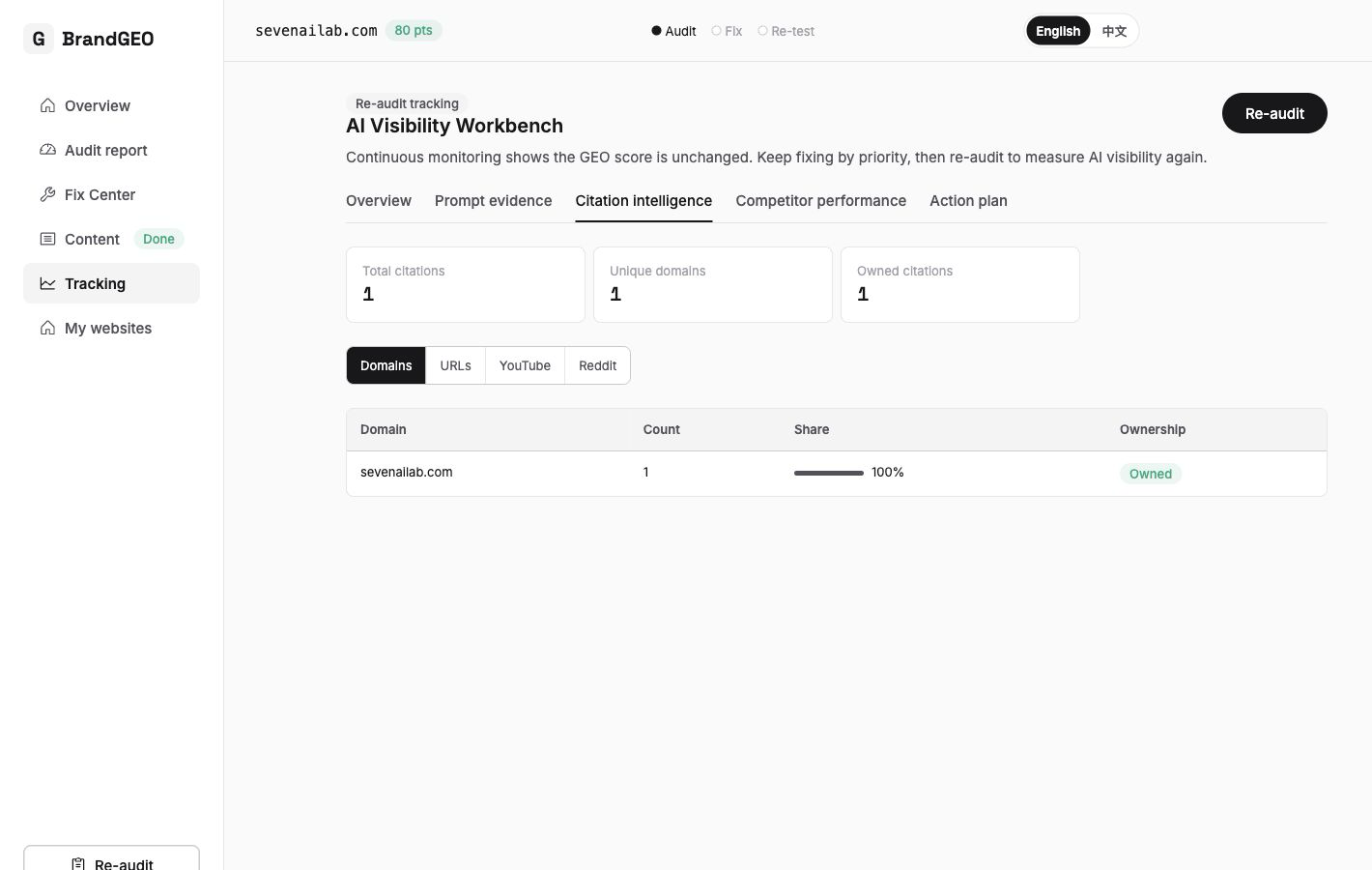
Questions where competitors consistently outrank you = gap analysis. Expand that row and check competitors' citation sources — what platforms cite them? If competitors have active discussions on Reddit, G2, and TrustRadius while you don't, that's your content gap. Click through to the Competitors comparison page for more systematic analysis.
Questions where you rank highly = protect your advantage. If you're stably ranked first or second on certain questions, examine what content drove AI to prioritize you — typically higher content quality on your website about that topic or greater density of third-party citations. Continue strengthening this content to prevent competitors from overtaking you.
If you're not sure what to do first, the Track dashboard's Actions priority plan page ranks recommendations based on all probe results.
What You'll See After This
After spending 10 minutes browsing the Prompts probe library, you'll have three clear insights:
- Which questions AI recommends you on — your visibility strengths
- Which questions AI ignores you on — your visibility blind spots
- Which questions competitors outperform you on — the gap you need to close
These three insights form the basis for your next actions. After each audit, Prompts data refreshes automatically. If you've just completed a round of technical fixes or content optimization, check back in a few weeks — have previously "not mentioned" questions turned to "mentioned"? Has the stance shifted from "neutral" to "recommended"? This is the practical operation of "validation" in the complete GEO closed loop.
The complete Prompts probe library view: from filters to per-question drill-downs, a single page showing your per-question AI search performance.
Frequently Asked Questions
Are the questions in the probe library fixed or customizable?
The library is automatically generated based on your category and competitors, covering different buyer intent stages. The breadth and specific questions depend on your industry and product type. Industry guidance recommends covering 30–100 different-intent questions, [3] with quality mattering more than quantity — covering different buyer journey stages (discovery, comparison, evaluation) is more valuable than repeating the same question type.
Do results for the same question vary a lot across platforms?
Significantly. Different AI models mention brands at very different rates — Claude mentions brands in 97.3% of responses, while Google AI Overviews does so in only 48.5%. [11] Citation rates also vary: Google AI Overviews at 71%, Perplexity at 62%, ChatGPT at 41%. [6] That's why using the platform filter to separately view results from different AI engines matters.
How is "brand stance" — Recommended, Neutral, or Negative — determined?
The system analyzes the text describing your brand in AI's response, assessing whether AI is actively recommending (e.g., "we recommend"), objectively describing (e.g., "[brand] offers [feature]"), or expressing reservations (e.g., "while [brand] has [strengths], there are [concerns]"). Spotlight's analysis of 1.8 million responses shows roughly 80.6% of mentions are neutral or positive. [7] But different platforms have different tendencies — ChatGPT acts more like a product advisor, expressing reservations on evaluative questions; Google AI Overviews is more likely to trigger negative mentions from news events. [8]
I retested and still got "not mentioned." What should I do?
Don't be discouraged — "not mentioned" does not mean "never mentionable." One practitioner guide cites cases improving within a 60–90 day window,[12] but 30%–40% is not a justified forecast for your brand. Find a testable lever instead: expand the row, inspect competitor citation sources, and treat gaps on Reddit, G2, or industry media as hypotheses. Start with the corresponding item in your action plan.
ChatGPT dominates AI search traffic. Is tracking only ChatGPT enough?
ChatGPT accounts for 87.4% of AI referral traffic, [13] but tracking only one platform isn't recommended. Google Gemini's referral traffic grew 388% year-over-year, and Google AI Overviews covers about 16% of Google search results pages. [6] More importantly, different platforms have different citation logic — visibility on ChatGPT doesn't guarantee visibility on Perplexity. Conversely, being completely invisible on any platform is a significant blind spot.
How do I know which "not mentioned" questions are higher priority?
Look at two dimensions. First, buyer intent — a high purchase-intent question like "recommend a [category] tool" is higher priority than an educational question like "what is [category]," because the former directly influences purchase decisions. Second, competitor performance — if competitors are consistently mentioned on a question while you're not, it means AI considers this category to have "correct answers" that don't include you, which is more urgent than AI not knowing the category at all.
What's the relationship between Prompts and Overview data?
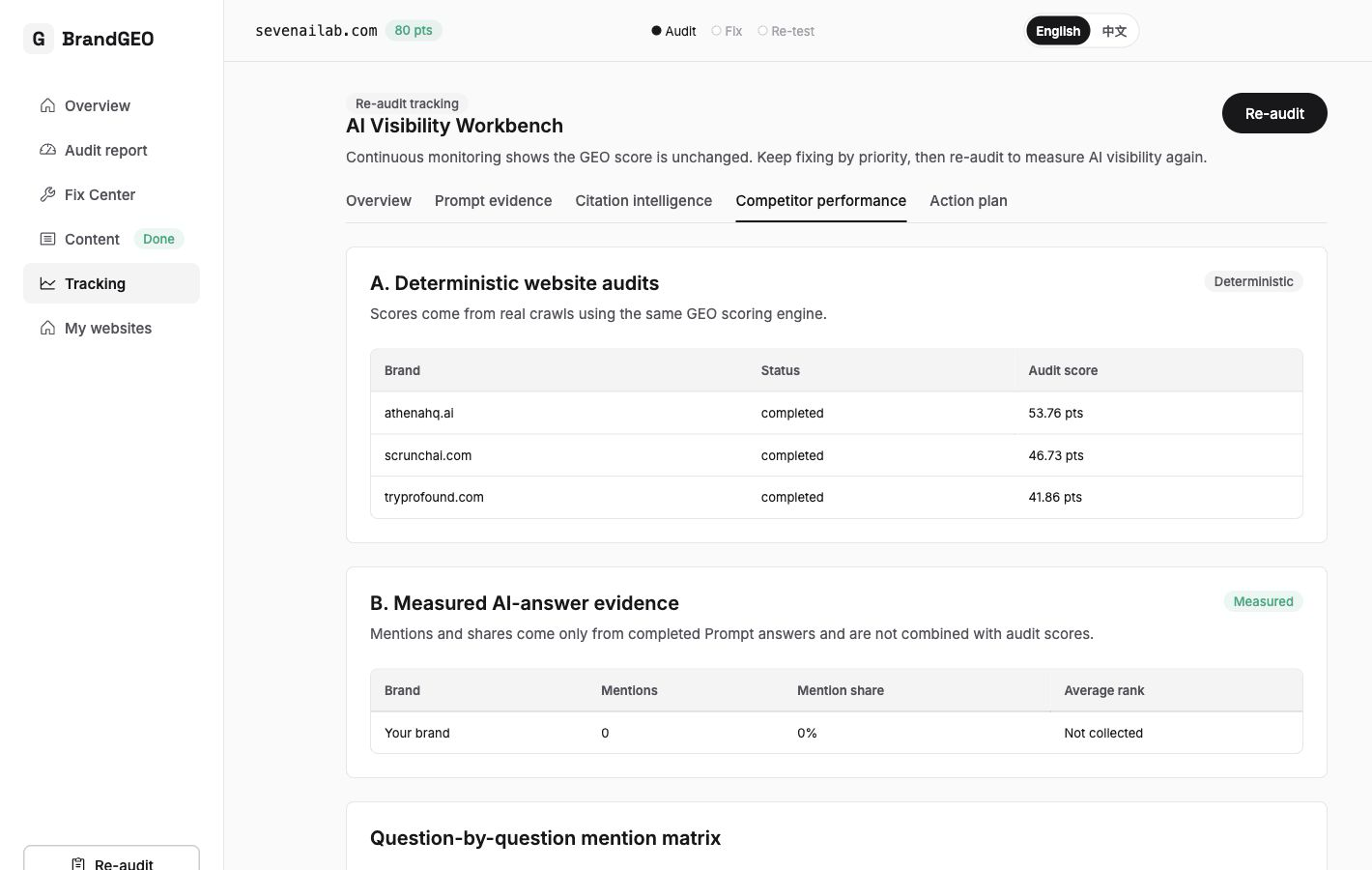
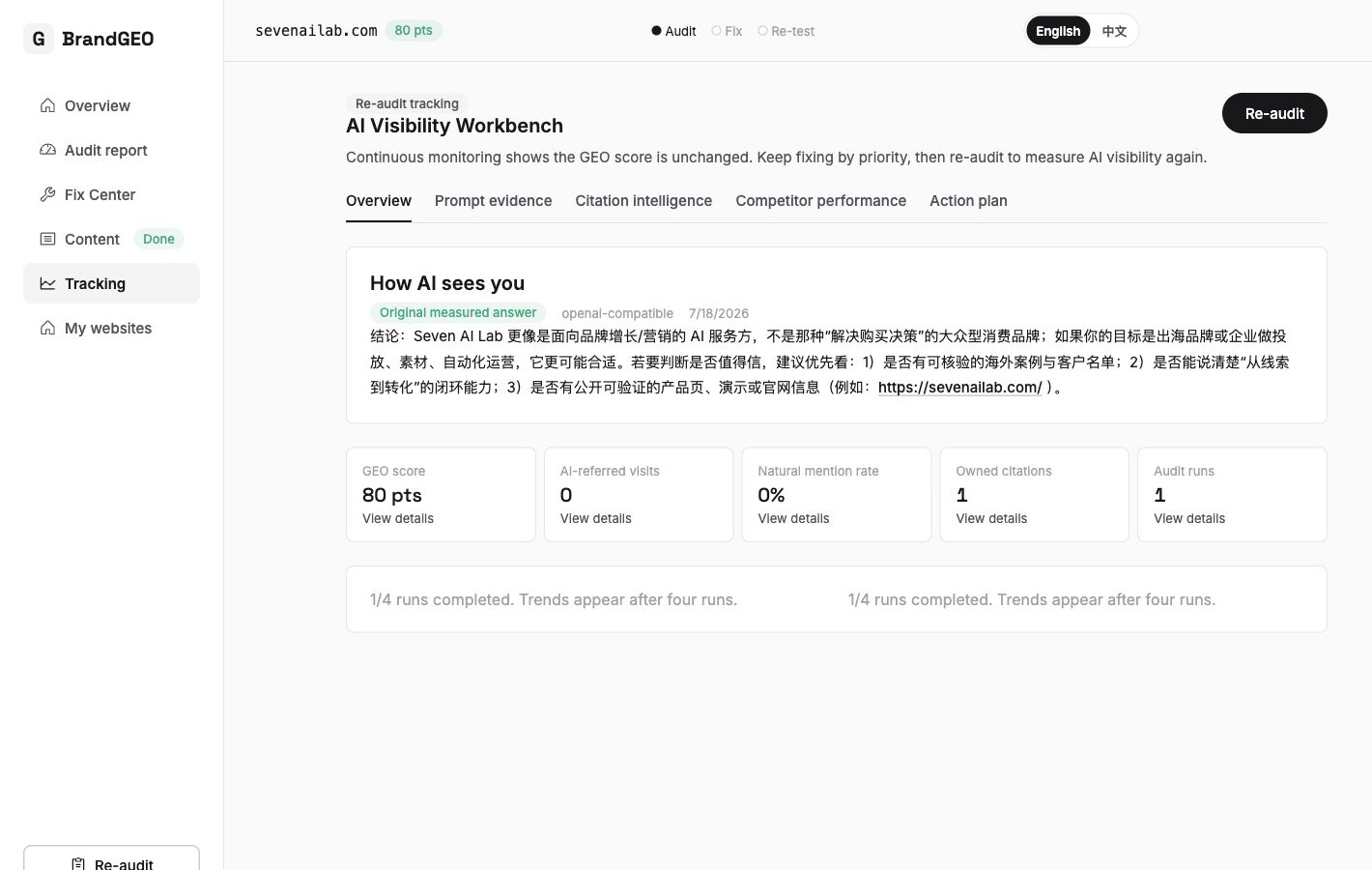
Overview is the aggregate summary of Prompts data — Overview's "AI Recommendation Count" equals the total number of "mentioned" questions in Prompts, and "Organic Mention Rate" equals mentioned count divided by total question count. Overview tells you "how things look overall"; Prompts tells you "which specific questions have issues." The typical flow is: spot anomalies in Overview, then drill into Prompts to locate specific causes.
Competitors rank above me in AI. What can I do?
Expand that row and check competitors' citation sources — where did AI learn about them? Then compare against your own citation sources. Common gaps include: competitors have Reddit discussion threads and you don't, competitors have more reviews on G2/TrustRadius, competitors are mentioned by industry media/blogs and you aren't. Since 84% of AI citations come from third-party sources, [9] closing these source gaps is typically more direct than optimizing your own website. Additionally, make sure your website has accurate, structured brand information — building a brand profile is the foundation.
Sources
- Fishkin, R. & O'Donnell, P. "Why AI Brand Recommendations Change With Every Query." SparkToro/Gumshoe.ai, 2025. 38% brand list variability across 2,961 AI responses. Summary
- Peec AI / Search Engine Journal. "Prompt Tracking: Does prompt variance % impact brand mentions?" 2026. 37,000+ AI responses analyzed; mentions stable when core intent consistent; ~50% visibility drop only at 0.35–0.39 similarity. Article
- SE Ranking / MaxAEO / Rankshift. "How Many Prompts to Track AI Visibility." 2026. 30–100 prompts recommended; 60 × 5 × 3 = 900 data points framework. SE Ranking · MaxAEO
- MaxAEO. "How to Create a Prompt Set for AI Brand Monitoring." 2026. Four input sources (SEO keywords / sales objections / category education / use cases). Article
- Visby AI. "Which AI Search Prompts Are Brands Monitoring Most in 2026?" 2026. 13 intent categories; Specific Brand Query 36.4%; Purchase Ready 8.4%. Article
- Vismore. "Best Ways to Track Brand Mentions in AI Search (2026 Guide + 750 Response Study)." 750-response audit; first-position 3.1× click-through advantage; Reddit citation 16-day median; cross-platform citation rate differences. Report
- Spotlight. "Comprehensive Guide to Sentiment Analysis of Brand Mentions in ChatGPT." 2026. 1.8 million AI responses; 80.6% neutral/positive; ChatGPT positive-to-negative ratio 27:1. Article
- BrightEdge. "When AI Goes Negative: Google AI Overviews vs ChatGPT." 2026. Google AIO 44% more likely to mention brands negatively. Report
- Muck Rack. "The State of AI Citations 2026." Across 25 million cited links, an average 84% pointed beyond brands' owned channels. Report
- Similarweb / ALM Corp. "ChatGPT Recommendations Drive 2.5x More Traffic." 2026. 2.5× visit probability for AI-recommended brands; B2B ChatGPT referral visits grew 303% YoY (645K → 2.6M). Report
- Rocketblue. "Tracking Brand Mentions in AI Chatbots (Feb 2026 data)." Claude 97.3% vs Google AI Overviews 48.5% brand mention rates. Article
- Vismore. "Best Ways to Track Brand Mentions in AI Search." 2026. Practitioner guide citing several improvements in a 60–90 day window, not a universal growth benchmark. Guide
- Conductor. "2026 AEO/GEO Benchmarks Report." November 2025. ChatGPT accounts for 87.4% of AI referral traffic. Report
Last updated: 2026-07-23
Want to know which questions AI mentions you on and which it ignores? Open BrandGEO for a free audit, then check the Track dashboard for probe results. Start your free audit